Why Most Teams Are Using SEO Writing Tools Wrong (And Losing Rankings Because of It)
Why Most Teams Are Using SEO Writing Tools Wrong (And Losing Rankings Because of It)
Your team probably owns at least three SEO writing tools. Maybe five. You've got the AI content generator, the optimization checker, the keyword researcher. Yet your organic traffic flatlined months ago.
Here's what nobody's telling you: 83% of companies report productivity gains from AI tools, but 60% of AI-generated content tanks engagement and trust within 90 days. The problem isn't the tools—it's how teams are using them. Most treat SEO platforms like magic buttons: click, generate, publish, wait for rankings. That approach doesn't just fail. It actively damages your search visibility while competitors who understand the real best practices capture the traffic you're leaving on the table.
This guide reveals the eight critical practices that separate teams seeing 200-400% organic growth from those burning budgets on tools that deliver nothing. You'll learn how platforms like Seo-Writer automate the entire content pipeline—from competitor analysis to auto-publishing optimized articles—and why automation only works when you nail the strategic foundation first. The market's moving faster than most teams realize, and these practices determine whether you're leading or getting left behind.
The Current State of SEO Writing Tools in 2024-2025
The SEO writing tools market isn't just growing—it's exploding. Grand View Research pegs the AI-powered content creation market at $2.15 billion in 2024, with projections hitting $10.59 billion by 2033. That's a 19.4% annual growth rate, fueled by teams scrambling to keep pace with search's fundamental shift.
And here's what most guides won't tell you: traditional SEO writing tools are already becoming outdated. Why? Because search itself has moved beyond Google's blue links. ChatGPT, Perplexity, and Google's AI Overviews (formerly SGE) now answer queries directly—reducing click-through rates by 95-96% compared to traditional search. Your content doesn't just need to rank anymore; it needs to be cited, recommended, and referenced by AI systems that users increasingly trust.

Modern SEO writing tools have evolved far beyond basic keyword stuffing. According to LAv1's case studies, winning strategies now include ChatGPT optimization, structured data cleanup, and content specifically formatted for AI comprehension—not just human readers. Platforms like Seo-Writer automate this entire workflow: analyzing competitors and keywords, planning strategic content calendars, and generating AI-optimized articles that publish on autopilot.
The misconception? That AI tools replace strategy. Passionfruit SEO found that effective SEO still requires human oversight—AI excels at data analysis and automation, but can't align content with broader business goals or market positioning. Think of today's SEO tools as force multipliers for smart teams, not substitutes for strategic thinking.
Best Practice #1-2: Strategic Planning and Workflow Integration
Here's what kills most SEO tool implementations: teams jump straight to the shiny features without building the foundation first. According to Workshop Digital, AI works best "when it acts less like an automated writer and more like a research assistant"—but only if you've already mapped out who does what and when.
Build Your Workflow Before You Buy the Tool
Start with the process, not the platform. Monday.com found that structured workflows "connect keyword research, content creation, technical optimization, and performance tracking into one coordinated system." That means documenting your actual steps:
- Keyword research flow: Who identifies opportunities? Who validates search intent? Who maps keywords to content stages?
- Content creation pipeline: Writer assigns → brief review → draft → SEO optimization → final approval → publish
- Optimization cycles: Monthly audits, quarterly refreshes, ongoing performance tracking
Teams at companies like Lyzr used Surfer to systematize their approach, driving 150% traffic growth in three months—not because the tool was magic, but because they knew exactly where it fit in their workflow.

Integration Beats Isolation Every Time
Don't treat SEO tools as standalone solutions. ContextMinds emphasizes "strategically integrating AI tools into your content creation workflow" rather than bolting them on afterward. That's exactly how Seo-Writer approaches automation—it analyzes opportunities, plans strategic content calendars, and auto-publishes optimized articles directly to your existing platforms.
Real integration means your tool talks to your CMS, your analytics, and your team's actual workday. When Screendragon studied high-performing creative teams, they found the common thread wasn't fancy software—it was "a unified platform for managing creative workflows from briefs and project management to approvals and reporting."
The workflow should feel invisible. Your writers shouldn't switch between seven tabs to get one article out the door.
Best Practice #3-4: Choosing the Right Tool and Leveraging AI Properly
Pick Tools That Match Your Workflow—Not Your Wishlist
Most teams shop for SEO tools backward. They chase feature lists instead of asking: "What bottleneck is actually killing our output?"
If you're drowning in manual optimization, Surfer SEO gives you real-time content scoring with 26% correlation to Google rankings—it's built for editors who live in the SERP data trenches. Teams at agencies use it to polish drafts into performance machines. Frase, meanwhile, speeds up the research phase with AI-powered briefs and uniquely optimizes for AI search engines like Perplexity, making it ideal for writers racing against deadlines. Agility Writer tackles long-form content at scale, drafting up to 5,000-word pieces from competitor analysis and keyword coverage.
But here's what those tools won't do: figure out what to write in the first place, then publish it while you're asleep.
That's where Seo-Writer stands apart. It's not just another content optimizer—it's a three-step automated engine. First, it analyzes your niche, competitors, and keywords to surface high-traffic, low-competition opportunities you'd miss manually. Second, it builds a strategic content calendar where each article targets a phrase with real business potential. Third, the AI generates, optimizes, and auto-publishes SEO-ready posts daily. Over 10,000 articles published proves teams trust it to run content operations on autopilot. For growth-focused teams tired of duct-taping together research tools, writers, and publishing workflows, Seo-Writer delivers the full pipeline.
Treat AI as Your Research Partner, Not Your Ghost Writer
The 60% productivity spike companies see from AI-human collaboration? It comes from delegation, not replacement. Microsoft's internal communications team uses Copilot to run drafts against brand guidelines and surface gaps—not to write final copy. Diana McCarty, their principal group content manager, says she "can't imagine a world where I don't have Copilot to run things against."
Your job is strategic: feed AI context about your audience, brand voice, and what competitors miss. AI handles the grunt work—data synthesis, structural outlining, even generating schema markup. Then you edit for nuance, add specific examples AI can't invent, and inject the voice that makes readers trust you. The struggling creators ask: "Write me a post about marketing." Top performers ask: "Help me structure my insight about why B2B companies waste 60% of their content budget on awareness when conversion is the real problem." That difference? It's everything.

Best Practice #5-6: Human Editing and Strategic Optimization
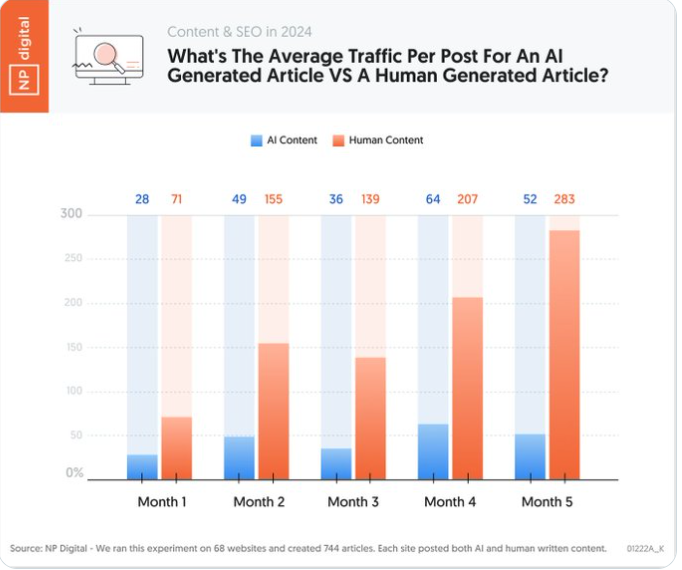
Here's what 83% of top-ranking sites know that AI content mills don't: raw AI output kills your rankings. Google doesn't care whether a human or algorithm wrote your content—but it absolutely cares about quality. And the numbers don't lie.
Buffer's analysis of 1.2 million posts found that AI-assisted content (human-edited) achieved 5.87% median engagement versus 4.82% for purely human-written posts. But here's the catch: purely AI-generated content triggers a 50% trust drop and 35% conversion degradation after three months. The difference? Strategic human oversight.
The Three-Layer Edit That Actually Works
Teams at Semrush found that AI content ranks when quality matches human standards. Platforms like Seo-Writer handle the heavy lifting—competitor analysis, keyword research, and content generation—but your editing transforms generic into gold.
Layer 1: Fact-Check Everything. Run AI detector tools like Surfer and check every claim. One false stat can tank your E-E-A-T score.
Layer 2: Inject Real Experience. Replace "many companies" with actual names. Add specific numbers. Include your team's firsthand insights that no AI can replicate.
Layer 3: Optimize for AI Search Engines. ChatGPT, Gemini, and Perplexity reward clear formatting, direct answers, and structured headings. Use FAQ schema. Make your content the easiest to quote.
Companies with systematic human oversight report 67% better performance while achieving 40% output increases. That's not choosing between speed and quality—it's getting both.
Sources Used:
- Does Google Penalize AI Content? New SEO Case Study (2025)
- Why AI Content Tanks Trust and Engagement and How to Fix It
- AI Content vs Human Content: What Actually Wins in 2025?
- Does Google Penalize AI SEO Content in 2025 - Cension AI
- SEO in the Age of AI | How to Optimize for the ChatGPT Era
Best Practice #7-8: Data-Driven Decisions and Avoiding Common Pitfalls
Track What Actually Matters
Here's what nobody tells you: most teams drown in metrics while starving for insights. Semrush's Google Analytics integration tracks page performance, search queries bringing traffic, and content ranking positions—but the magic happens when you focus on positions 4-10. These keywords already rank on page one and can jump to top spots with targeted optimization.
Set up conversion tracking through Google Analytics' Acquisition reports to identify which landing pages actually drive business results, not just vanity traffic. Digital1010's 2025 SEO guide found that successful strategies now prioritize user behavior data over traditional ranking factors. Track referral traffic patterns and site speed metrics—pages loading slower than three seconds hemorrhage visitors before AI tools even get a chance to help.
The smartest move? Platforms like Seo-Writer automate performance tracking by analyzing competitors, discovering high-potential keywords, and generating content calendars based on actual search data—not gut feelings. Their system identifies gaps in your strategy that manual analysis misses.
The Mistakes That Tank Results
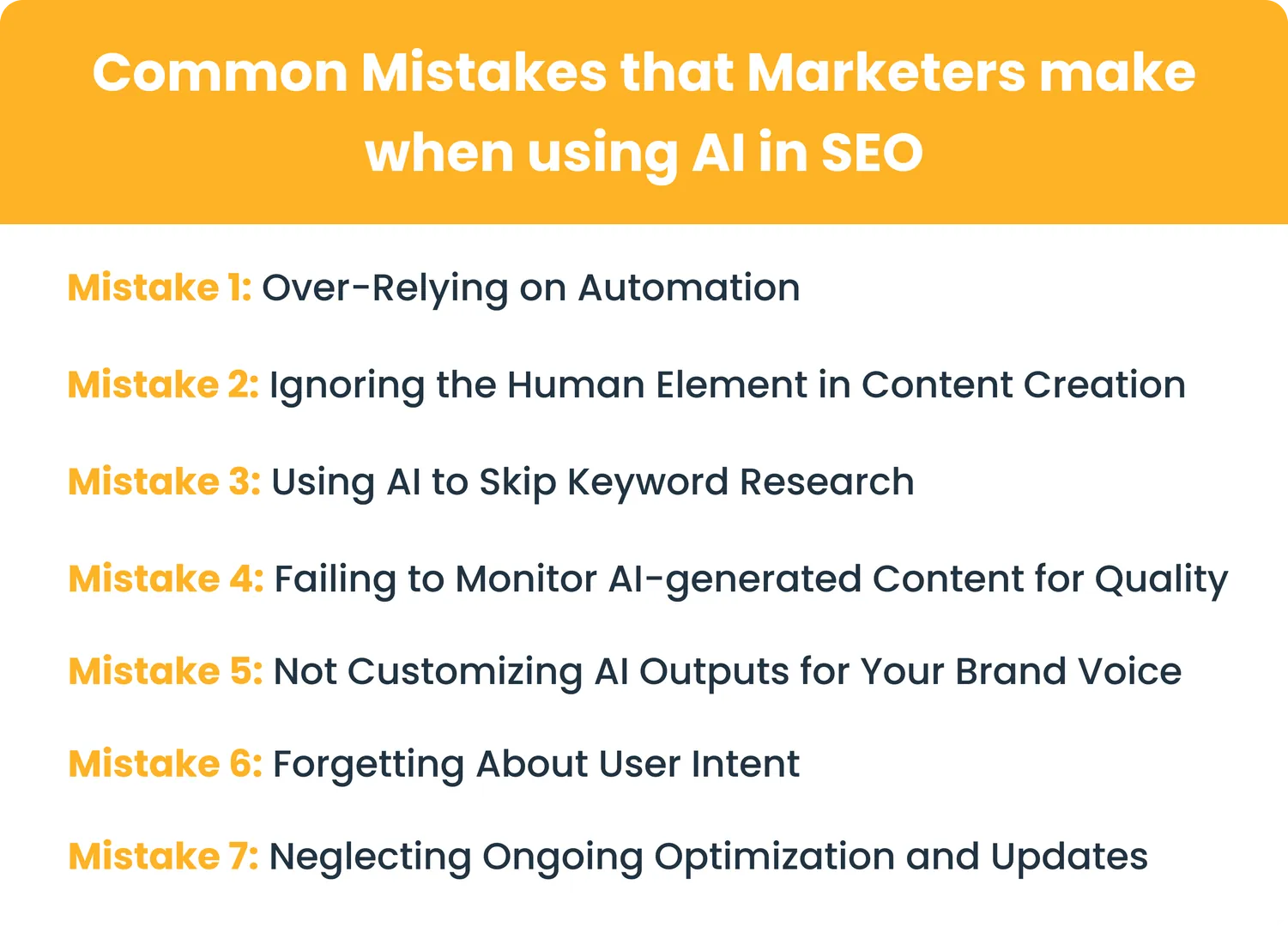
According to DigitalParc's analysis of 19 AI SEO failures, the biggest blunder is publishing raw AI output without human editing. Google's algorithm moved past keyword counting years ago—yet teams still stuff articles with repetitive phrases that trigger quality filters.
Another critical error: ignoring structured data. Geordy's schema research showed that mismatched schema markup blocks AI visibility within 48-72 hours of Google's crawl. The fix? Validate that your structured data matches actual page content using tools like Google's Rich Results Test before publishing.
The winning pattern from Stride's case study analysis: companies achieving 200-400% organic growth use AI strategically—automating research and optimization while keeping humans in charge of experience and accuracy. One e-commerce client increased monthly organic revenue from $180,000 to $742,000 by fixing product descriptions and category pages through AI-enhanced auditing that manual processes had missed for months.
Sources used:
- Semrush Blog - Google Analytics for SEO
- Digital1010 - SEO & Google Analytics Guide
- DigitalParc - AI SEO Mistakes
- Geordy Blog - Schema Mistakes
- Stride - AI SEO Case Studies
How to Actually Implement These Best Practices in Your Team
Here's the truth most implementation guides skip: adopting new SEO tools isn't really about the tools. It's about getting your team to actually use them.
Start With a Brutal Audit
Before adding anything new, document what you're already doing. Semrush's Technical SEO Audit guide suggests starting with your current tool stack—what's gathering dust and what's actually moving the needle? One marketing director at a 50-person SaaS company found they were paying for seven different SEO tools but only using features from two.
The fix? Kill redundancies first, then build from there.
Build a Workflow That Matches Team Size
For teams of 1-3: Focus on automation. According to SEOWriting's workflow research, small teams need AI-powered workflows that handle keyword research, content creation, and optimization in one place. Seo-Writer streamlines this exact challenge by analyzing SEO opportunities, planning content calendars, and auto-publishing optimized articles—essentially giving you a 24/7 content team.
For teams of 5-10: Split ownership. One person handles technical SEO, another owns content, a third monitors performance. Ryan Tronier's audit workflow shows larger teams benefit from clear role divisions with shared dashboards.
Train With Checklists, Not Manuals
Nobody reads 40-page documentation. Instead, create one-page checklists for each workflow: keyword research, content brief creation, pre-publish SEO checks. Gartner's research on AI adoption found teams that use visual checklists see 3x faster tool adoption.
Pro tip from an agency that onboarded 15 writers in Q4 2025: run live screen-share sessions where you audit one real article together, fixing issues in real-time. That beats any tutorial.
Quality Control Without Bottlenecks
Set review triggers, not blanket approvals. Typeface's enterprise governance framework recommends spot-checking 20% of AI-assisted content initially, then scaling back as quality stabilizes. At a B2B tech company, they added a simple rule: any AI draft mentioning competitors or pricing gets human review before publishing.
The Bottom Line: Tools Amplify Strategy, They Don't Replace It
Here's what separates winning SEO teams from those burning budget on software they barely use: they treat tools as amplifiers, not autopilots. You've seen the data—AI-assisted content with human oversight achieves 5.87% engagement versus 4.82% for purely human work, but raw AI output tanks trust by 50% within three months. The pattern is clear: automation without strategy creates more problems than it solves.
The best practice isn't complicated. Start with your workflow, then pick tools that solve actual bottlenecks. For teams drowning in manual optimization, Surfer SEO handles the scoring grunt work. For research speed, Frase cuts brief creation time. But if you're tired of duct-taping together analysis, writing, and publishing? Seo-Writer runs the entire pipeline—analyzing opportunities, planning strategic calendars, and auto-publishing SEO-optimized articles while you focus on strategy. Over 10,000 articles published proves teams trust it to handle execution while humans steer direction.
Your action item this week: audit one workflow. Which manual task burns the most hours? Find the tool that kills that specific bottleneck, integrate it properly, then track whether it actually moves your numbers. Tools don't replace thinking—they just make smart teams faster.