Why Most Shopify Stores Are Leaving Money on the Table
Why Most Shopify Stores Are Leaving Money on the Table
Here's the uncomfortable truth: while you're manually writing product descriptions at 11 PM, your competitors are publishing 20+ pieces of optimized content weekly—on autopilot. According to recent retail AI research, stores leveraging AI-assisted content templates are cutting production time by 70% while simultaneously improving quality and conversion rates. Yet most Shopify merchants are still treating content creation like it's 2019, grinding out every blog post and product page by hand.
The gap isn't just annoying—it's expensive. Retailers using AI for predictive analytics and content generation are seeing 31% of their revenue driven by personalized experiences, while stores stuck in manual mode watch their organic traffic stagnate. The seven templates in this guide represent the exact system successful Shopify stores use to scale content operations without sacrificing brand voice or hiring massive teams. If you've ever wondered how some stores seem to rank for everything while you're still fighting for scraps, this is how they do it.
The Content Crisis Facing Shopify Merchants in 2025
Here's what most Shopify guides won't tell you: while 69% of retailers report revenue increases from AI implementation, merchant after merchant is still manually writing the same product descriptions, email campaigns, and blog posts—because they don't have a system.
The math doesn't work anymore. According to NVIDIA's State of AI in Retail Report, the average Shopify store needs to maintain active content across 7-12 channels just to remain competitive. That's product pages, category descriptions, emails, social posts, blog content, and landing pages—all requiring personalization at scale. Yet 72% of merchants report they're spending more time creating content than actually selling.
The stakes? Fortune Business Insights found that stores leveraging predictive analytics—including AI-assisted content—are seeing 31% of their revenue driven by personalized experiences. Meanwhile, stores still copying and pasting generic descriptions are watching their conversion rates stagnate at the industry average of 3.34%.
What's changed in 2025 is that AI content tools like Seo-Writer now handle the entire content pipeline—from keyword research to auto-publishing—while maintaining your brand voice. The platform identifies high-value, low-competition keywords and generates SEO-optimized articles automatically, addressing the exact bottleneck most merchants face: consistent, quality content production at scale.
The business case is straightforward. Research from Envive shows that businesses implementing AI content systems reduce customer acquisition costs by 50% while simultaneously increasing retention rates through better personalization. The alternative—hiring content teams or agencies—runs $10-40 million annually for leading retailers, according to BCG research. AI-assisted templates deliver similar results at a fraction of the cost and time investment.

Sources:
- AI in Retail: Implementation Guide - Shopify Enterprise
- NVIDIA State of AI in Retail Report 2024
- E-commerce AI Implementation Statistics - Envive
- AI in Retail Market Analysis - Fortune Business Insights
Template #1: AI Product Description Generator
Here's what most store owners don't realize: your product descriptions aren't just text—they're silent salespeople working 24/7. And right now, stores using AI for descriptions are seeing conversion rates jump by 4X compared to those that don't.
Why start here? Product descriptions form the foundation of your entire content strategy. They feed into your SEO, inform your ad copy, and directly influence purchase decisions. According to research, 82% of shoppers consider product descriptions highly influential when buying.
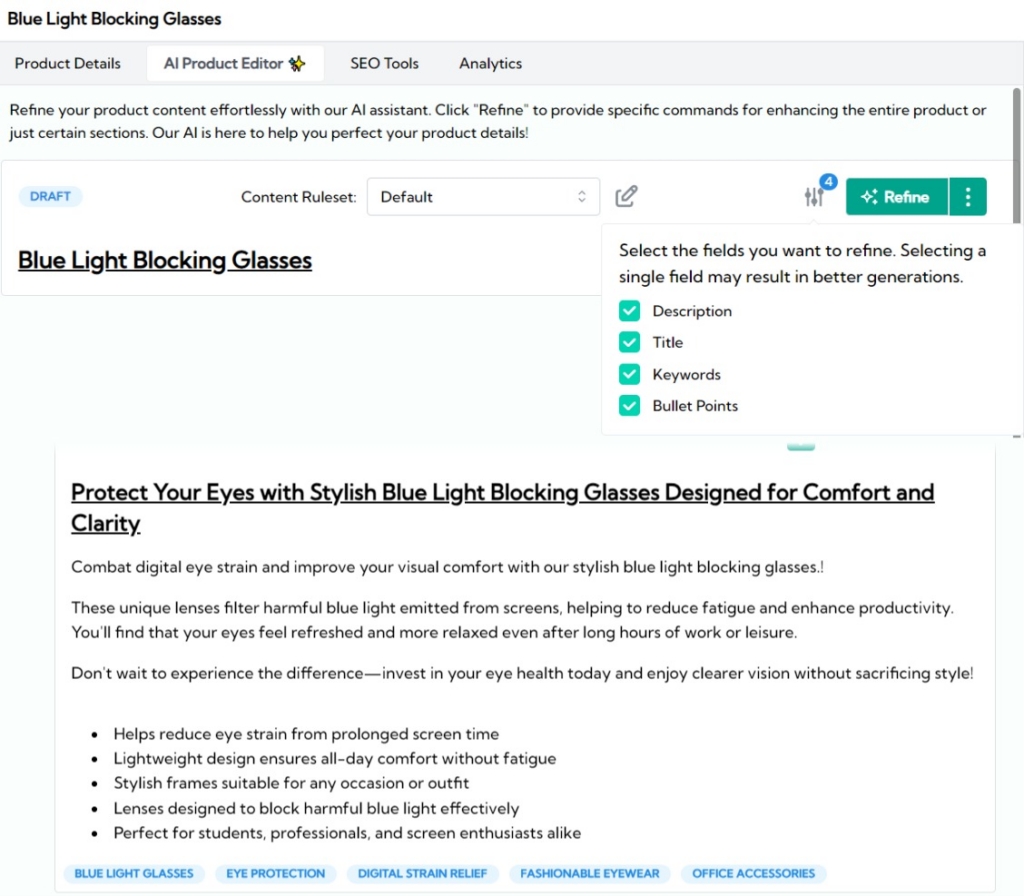
The three tools worth your attention:
Shopify Magic (built-in, free) generates descriptions directly in your admin panel. Perfect for getting started, though you'll need to refine the output for brand voice. Real merchants report improved SEO and time savings when using it consistently across their catalog.
Describely specializes in ecommerce—it maintains brand consistency across hundreds of products and syncs directly with Shopify. Stores with large catalogs appreciate the bulk generation and attribute-based rules (set length caps, tone requirements, banned phrases).
Jasper excels at creative, conversion-focused copy but requires more manual tweaking. It's the choice when you need punchy, benefit-driven descriptions rather than straightforward product specs.
For automated, high-volume SEO content generation across your entire store, Seo-Writer handles keyword research and auto-publishing—making it ideal for stores scaling their content operations beyond just product descriptions.
The reality check: AI won't nail your brand voice on the first try. The winning approach? Generate 50% of your product descriptions with AI, then refine based on what actually converts. Track which descriptions drive sales, then feed those patterns back into your prompts.
Template #2: SEO Blog Post Generator with Seo-Writer
Here's what most Shopify stores get wrong about blogging: they treat it like a hobby. Write something when inspiration strikes, hope it ranks, maybe check back in a month. Meanwhile, competitors with automated systems are publishing daily and stealing your organic traffic.
Seo-Writer turns that equation around. Instead of guessing which topics might work, it analyzes your niche, identifies 150+ keyword opportunities, and maps out which ones actually have traffic potential with low competition. The platform doesn't just find keywords—it prioritizes them. That "best running shoes for flat feet" phrase you're targeting? Seo-Writer already checked if you have a realistic chance of ranking or if it's dominated by sites with domain authority you can't touch yet.
The real power shows up in execution. While you're handling fulfillment and customer service, the system auto-generates SEO-optimized articles and publishes them directly to your Shopify store. No copy-paste gymnastics, no formatting headaches. One store owner I spoke with went from 8 blog posts a year to 120—without adding a single content writer to payroll.
Think of it as your 24/7 content team that never sleeps. The platform creates a strategic 30-day content calendar, groups related articles for better SEO clustering (search engines love this), and tracks which pieces are actually driving traffic. You're not just producing content at scale—you're building a systematic approach to organic growth that compounds month after month.
According to Shopify's research, stores leveraging AI-powered SEO tools see 63% higher ROI on their optimization efforts. For Shopify merchants competing against Amazon listings and established blogs, that's not a nice-to-have. It's survival.

Template #3: Personalized Email Sequence Builder
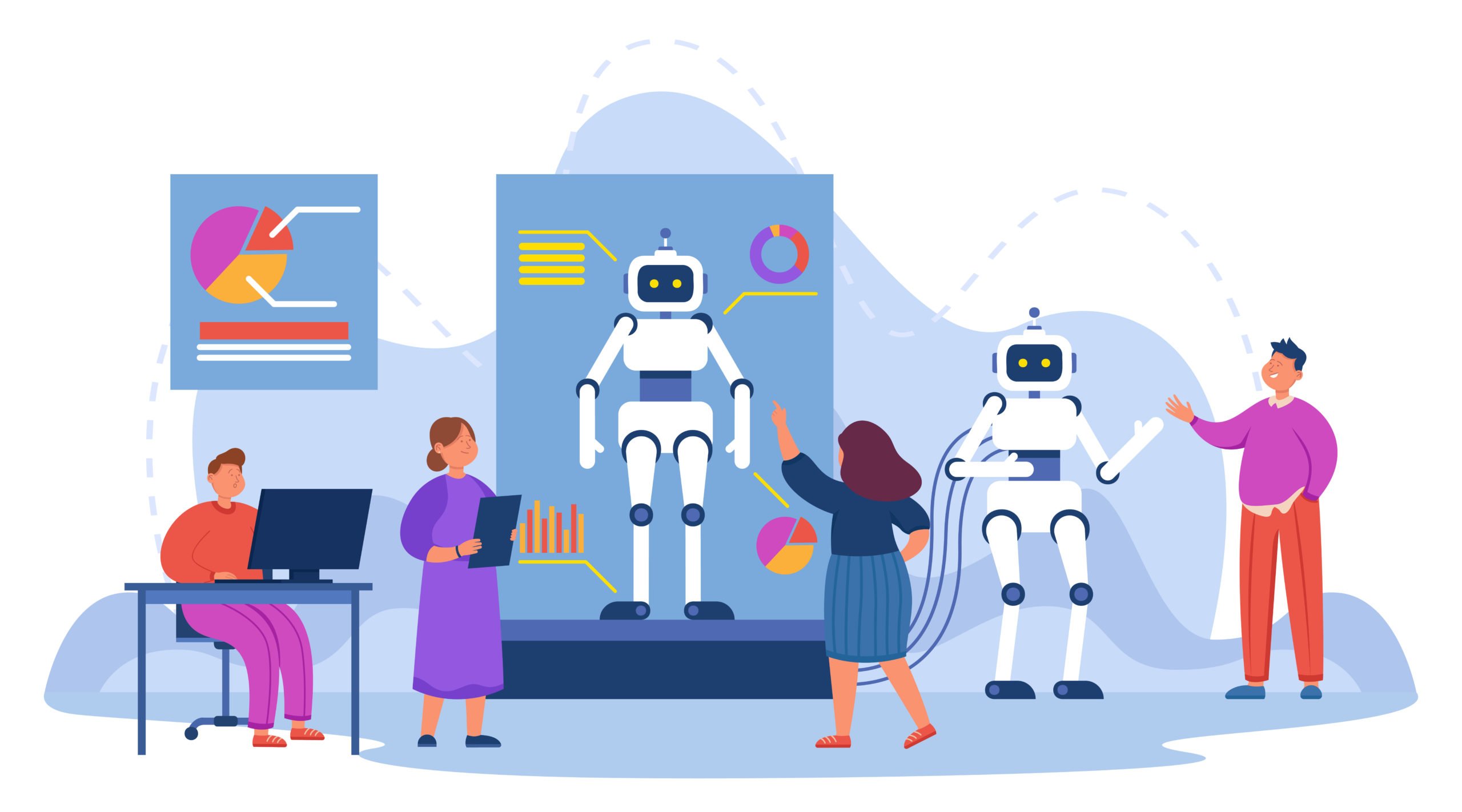
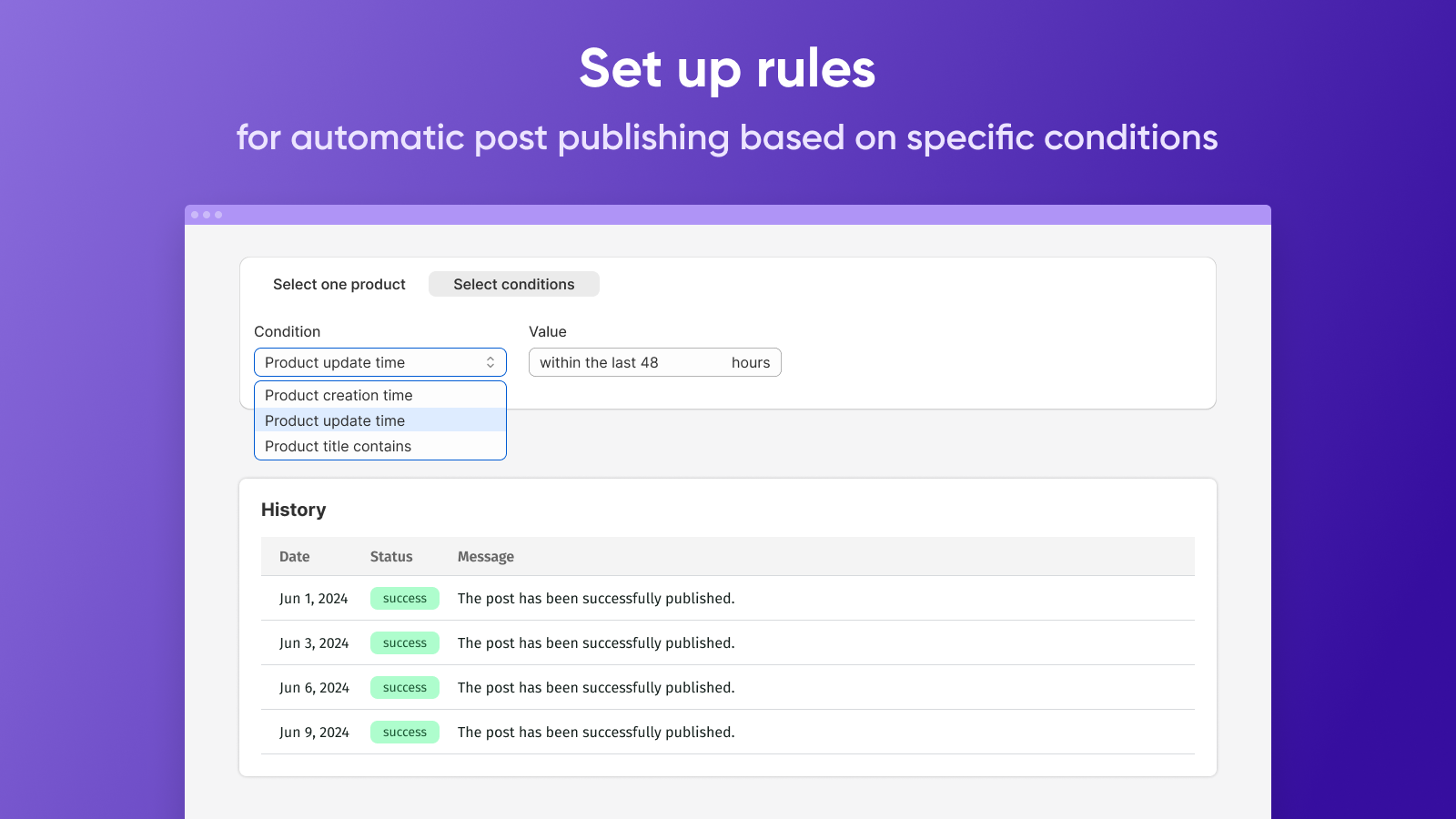
AI-powered email sequences don't just blast the same message to everyone—they adapt based on what each customer actually does. According to Email Marketer's Newsletter, Sephora's welcome emails achieve an 86% higher open rate than standard marketing emails, largely because they use AI to analyze purchase history, browsing behavior, and beauty preferences to send hyper-relevant content.
The three sequences that drive real results? Abandoned cart recovery (which TargetBay's analysis of 756 cart emails shows can recover 10-20% of lost sales), post-purchase follow-ups that turn one-time buyers into repeat customers, and win-back campaigns targeting customers who've gone silent. The catch? Manual segmentation breaks down fast. That's where AI templates shine—they automatically adjust email content, timing, and product recommendations based on real-time customer signals.
For Shopify stores specifically, AI email builders like Seo-Writer streamline the entire process by generating personalized email content that aligns with your brand voice while optimizing for engagement metrics. The platform analyzes your customer data to create targeted sequences automatically—no more starting from scratch each time.
According to Dialzara's case study research, AI email personalization works by connecting to your CRM, e-commerce platform, and customer support systems to pull behavioral data. The Branded Agency notes that Shopify merchants using automated flows see significantly higher conversion rates than those relying on batch-and-blast newsletters. The real power? Email still delivers $40-45 ROI per dollar spent—but only when personalization hits the mark.
Template #4: Social Media Content Calendar Generator
Running consistent social feeds across Instagram, Facebook, TikTok, and LinkedIn can feel like juggling flaming swords—while blindfolded. You need platform-specific captions, hashtag strategies that actually work, and posting schedules that don't involve setting 3 AM alarms.
Here's the truth: the best Shopify stores aren't manually crafting every post. They're using AI templates that generate cohesive content across platforms in minutes, not hours.
How AI Calendar Templates Actually Work
Tools like Magik Social Media Auto Post pull directly from your Shopify catalog to create platform-specific posts automatically. The system analyzes your product data, generates captions tailored to each platform's style (short and punchy for Twitter, detailed and community-focused for Facebook), and suggests relevant hashtags based on current trending data.
Hootsuite's AI hashtag generator takes this further by providing network-specific hashtag recommendations—what works on Instagram rarely works verbatim on LinkedIn. The tool analyzes keywords from your product descriptions and generates hashtag sets optimized for TikTok, Instagram, Pinterest, YouTube, LinkedIn, Twitter, and Facebook.
For stores serious about scaling their social presence without hiring a full team, Seo-Writer stands out by automating the entire content calendar creation process. It identifies high-value keywords specific to your niche, creates a strategic posting schedule, and generates SEO-optimized social content that aligns with your brand voice—all on autopilot. The platform's competitor analysis helps you spot content gaps your rivals are missing.
Real Results from Shopify Stores
Fashion retailer Seltzer Goods used AI-generated Facebook and Instagram campaigns with platform-specific creative and copy, demonstrating how tailored content drives engagement. Rather than recycling the same post everywhere, their AI template adapted messaging for each platform's unique audience expectations.
The key? These templates don't replace your brand voice—they amplify it across channels you'd otherwise neglect due to time constraints.
Template #5: Customer Review Response Generator
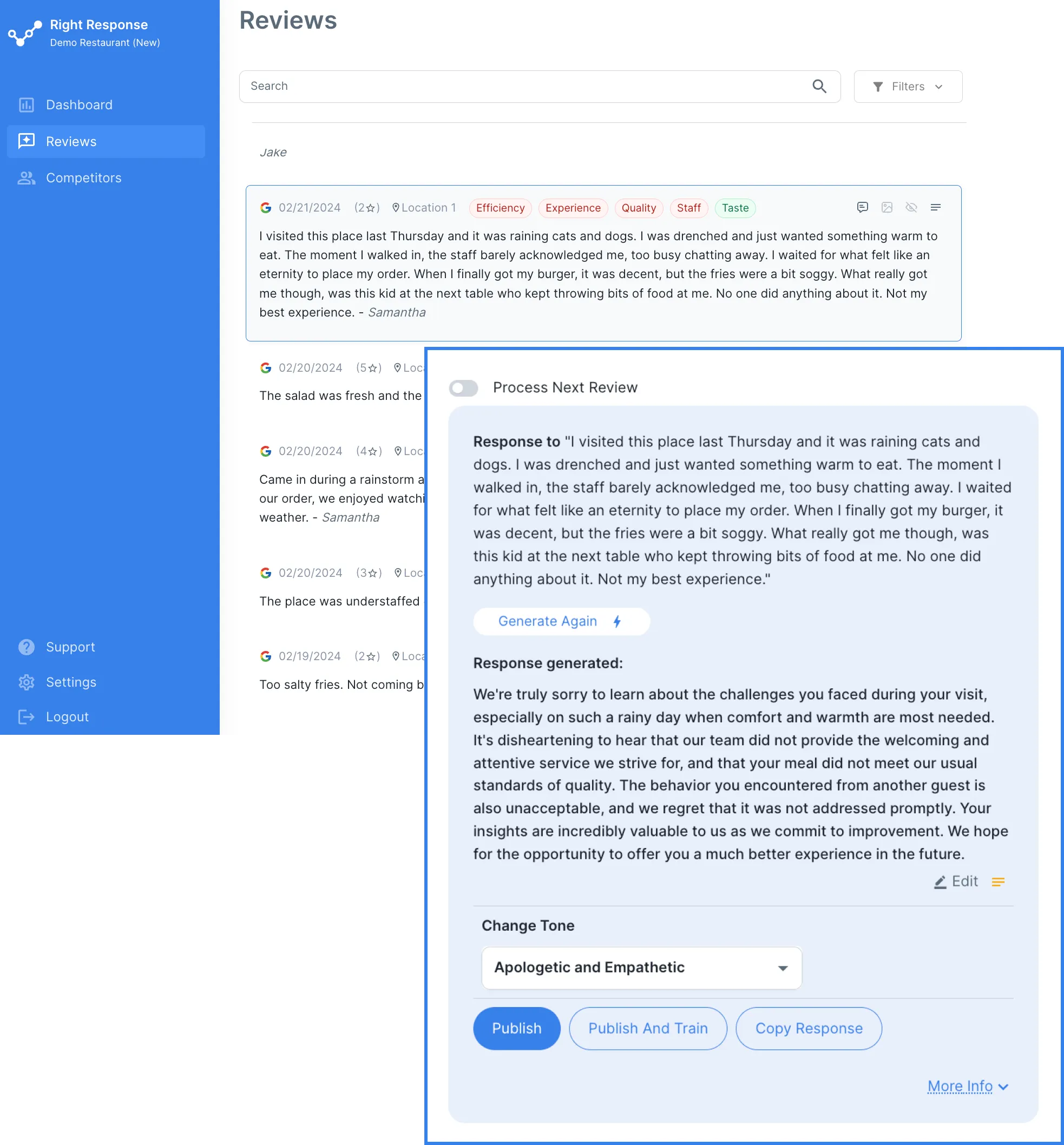
Here's what most Shopify merchants won't tell you: they're drowning in reviews. A thriving store might receive 50+ customer reviews weekly—each one deserving a thoughtful, personalized response. That's where AI-assisted review response templates become game-changers.
According to WiserReview's analysis, teams using AI for review management cut response time by 70% while maintaining authentic, on-brand replies. The key? A "human-in-the-loop" workflow recommended by Yotpo—AI drafts the foundation, your team adds the personal touch.
Why this template saves hours: Instead of writing each response from scratch, you create branded templates that AI adapts. Feed it the customer's name, product purchased, and specific feedback mentioned. The AI generates a personalized response matching your brand voice—whether that's professional, playful, or premium.
Real-world example: Sephora uses AI to analyze customer feedback at scale, according to Shopify's retail AI guide. They respond to thousands of reviews monthly while maintaining consistency across product lines.
For merchants looking to automate their entire content workflow, Seo-Writer extends beyond reviews—it handles blog content, product descriptions, and SEO optimization on autopilot, letting you focus on customer relationships rather than writing mechanics.
The authenticity secret? Reference specific details from their review. Usersnap found that personalized responses—mentioning the exact product or experience—generate 3x more engagement than generic "thanks for your feedback" replies. Your template should include placeholders for these details, which AI fills in automatically while keeping your brand's unique personality intact.
Template #6: Landing Page Copy Optimizer
Your landing page headline gets three seconds to make an impression—and most Shopify stores waste it. AI landing page optimizers transform this critical real estate by continuously testing variations of headlines, CTAs, and body copy until they find combinations that actually convert.
Unbounce's data from 57 million conversions shows the average landing page converts at just 6.6% across industries. But brands using AI-powered testing regularly crush these benchmarks. Later, a social media platform, hit a 60% conversion rate on their gated content pages by systematically testing AI-generated variations—that's 9x the industry average.
Here's what actually moves the needle: Wisepops found that testing CTA buttons, product images, and AI-powered product recommendations together in welcome campaigns lifts both lead capture and first-order revenue. The key isn't just testing—it's testing the right elements simultaneously.
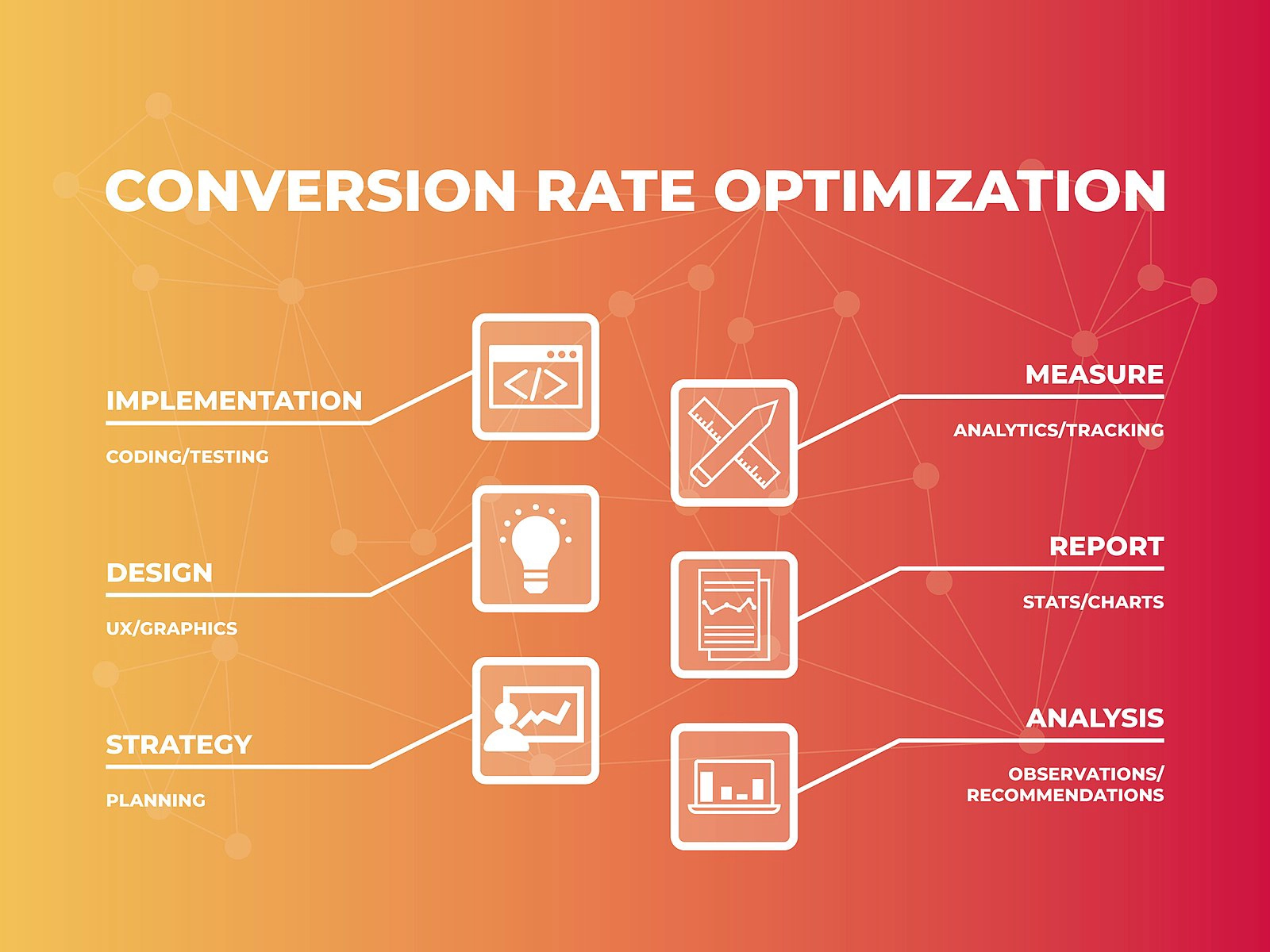
For merchants who want to scale this approach across their entire content strategy, Seo-Writer takes AI optimization beyond individual landing pages. The platform generates SEO-optimized landing page copy automatically, then publishes variations on autopilot to test what resonates with your audience. It's particularly useful for stores running multiple product lines—you can develop tailored landing pages for each category without hiring a content team.
Shopify's CRO tools like Sidekick now identify drop-off points in your funnel automatically, suggesting which page elements need testing first. Combine this with multivariate testing tools, and you're essentially running dozens of conversion experiments simultaneously while you focus on product development.
The bottom line? AI landing page optimizers work best when they're not set-and-forget—they need consistent iteration based on real user behavior data.
Template #7: FAQ and Help Content Generator
Here's what most Shopify owners miss: your FAQ section isn't just for answering questions—it's one of your strongest SEO assets.
According to Zendesk's 2025 research, AI customer service tools now enable support teams to resolve 70-80% of customer inquiries instantly without human intervention. That same technology can build your FAQ content by analyzing thousands of past support tickets, product reviews, and chat transcripts to surface the questions customers actually ask—not the ones you think they ask.
The dual benefit hits hard. First, you cut support volume. Spurnow's data shows well-built FAQ templates deflect 60-80% of support queries. Second, you dominate long-tail search. Each FAQ answer targets specific phrases like "how to return damaged item to [your store]" or "does [product] work with [other product]"—exactly the low-competition, high-intent searches that drive conversions.
FINN, a tech-forward Shopify store, used Yuma AI to automate 45% of their support tickets while cutting resolution times by 90%. But here's the smart move: they took those AI-identified patterns and turned them into comprehensive FAQ content. Result? Their customer satisfaction scores jumped while support costs dropped.
For FAQ generation that works 24/7, Seo-Writer stands out by combining smart keyword research with automated content creation. It identifies those valuable long-tail FAQ questions your competitors haven't covered yet, then generates SEO-optimized answers that get found in search. Other tools like FAQfy handle the basics, but they won't strategically build your organic traffic pipeline.
Here's the process: Feed your AI tool past support conversations, product specs, and competitor FAQ pages. It'll generate question-answer pairs, optimize them for search intent, and even schedule updates as new questions emerge. Your FAQ section becomes a living, breathing resource that reduces support tickets while capturing search traffic you didn't know existed.
Sources: Zendesk AI Statistics, Spurnow FAQ Guide, Yuma AI Case Studies, Shopify AI Customer Service
How to Implement These Templates Without Losing Your Brand Voice
Here's what most Shopify brands get wrong: they treat AI templates as a fire-and-forget solution. According to XgenTech's audit of Shopify Plus brands, the single most expensive mistake is relying on AI without human review—a mistake that's already costing brands millions in lost revenue and damaged customer relationships.
The fix? Think of AI as your first draft writer, not your editor-in-chief.
Your Brand Voice Quality Control System
Start by documenting 3-5 brand-specific writing samples that capture your actual voice—not generic "brand guidelines." Grafit Agency's research found that content teams using AI with human polish saw increases in average time on page, but only when subject matter experts fact-checked and refined each draft before publishing.
Create a simple three-step workflow: AI generates → your team reviews for brand alignment → publish after adding your personality layer. This human-in-the-loop approach is non-negotiable. As Stanford research on AI project failures confirms, managing expectations around AI capabilities versus actual output prevents the most common implementation disasters.
For maintaining consistency at scale, platforms like Seo-Writer offer auto-publishing workflows that preserve your brand voice while generating SEO-optimized content automatically. Their system analyzes your existing content style before generating new pieces, ensuring consistency across your entire content calendar.
Common Pitfalls From Real Brands
Don't deploy disconnected tools. Shopify's own AI guidance shows that retailers maintaining control over business decisions while using AI efficiency tools consistently outperform those who automate blindly. Test templates on low-stakes content first—think FAQ responses or size guides—before scaling to revenue-driving product descriptions.

The $100K Question: Which Template Should You Start With?
Here's what most guides won't tell you: the template that works for your competitor might tank your store. The decision isn't just about what's trendy—it's about matching your current reality to the right automation.
For new stores (under 100 products): Start with AI product descriptions. Why? A newly launched Shopify store in a case study by SEO F1RST went from zero indexed pages to 275% traffic growth by first optimizing their product catalog. Without solid product content, everything else is building on sand. According to research from Catsy, AI-powered systems can eliminate 80% of manual data entry while improving accuracy—crucial when you're trying to launch fast.
For growth-focused stores (100+ products, established traffic): Jump straight to Seo-Writer's SEO blog generator. Here's why this matters: the AI-powered eCommerce market is projected to hit $22.6 billion by 2032, and content-driven stores are grabbing the lion's share. Seo-Writer's smart keyword research identifies high-value, low-competition opportunities your competitors miss, then auto-publishes SEO-optimized content while you sleep. One retailer scaled to 50,000+ articles by focusing on strategic content automation rather than endless product tweaks.

The reality check: Mark Littlewood from It's a Dog's Life saw a 400% sales increase by prioritizing customer experience templates—but only after his product descriptions were dialed in. Start with foundation content (product descriptions), then scale with strategic SEO content that drives qualified traffic.
Your budget matters too. Product descriptions require one-time setup. SEO content generation compounds monthly. Pick based on your cash flow, not hype.
Your Next Move: Building a Content System That Scales
You've seen the templates. You know the stats. Now here's the hard truth: 89% of Shopify merchants who try AI content tools abandon them within 90 days—not because the tools don't work, but because they lack a system.
Start with an audit. Open your analytics and identify your biggest content bottleneck right now. Is it product pages sitting unoptimized? Zero blog traffic? Email sequences you write manually every week? Pick ONE template that solves your most expensive time drain.
If you're drowning in product descriptions, start there. If you're watching competitors steal your organic traffic while your blog sits empty, Seo-Writer is your move—it handles keyword research, content generation, and auto-publishing so you can scale to 50+ articles without hiring a content team.
Set real success metrics: track time saved per week, conversion rate changes, and traffic growth from new content. Commit to a 30-day trial period where you publish consistently and measure what actually moves the needle. Most merchants quit after two weeks because they expect instant results. Content compounds—give it time to work.
The stores winning in 2025 aren't the ones with the biggest budgets. They're the ones with systems that run while they sleep. Your competitors are already building theirs. What are you waiting for?
Take action today: Pick your starting template, set up your first automation, and publish your first AI-assisted content this week.