7 AI-Powered SEO Strategies for Shopify Stores That Actually Work in 2025
7 AI-Powered SEO Strategies for Shopify Stores That Actually Work in 2025
Picture this: You've spent months perfecting your Shopify store's product descriptions, obsessing over keywords, and climbing Google's rankings. Then one morning, you check your analytics and discover your hard-won traffic has mysteriously evaporated. What happened? Google's AI Overviews now appear in 16% of eCommerce searches, and 60% of searches end without a click because AI summaries answer questions directly. Your competitors didn't just optimize for Google—they optimized for ChatGPT, Perplexity, and every AI assistant reshaping how customers discover products. The brutal truth? Traditional SEO alone won't cut it anymore. In this guide, you'll discover seven AI-powered strategies that successful Shopify stores are using right now to dominate both traditional search and AI-generated recommendations. These aren't theoretical tactics—they're battle-tested methods delivering measurable results: 20% AOV increases, 30% cart abandonment reductions, and visibility where your customers are actually searching. Ready to future-proof your store's visibility?
The AI Search Revolution: How Shopify Stores Must Adapt in 2025
The search landscape has fundamentally shifted, and Shopify store owners who haven't noticed are already losing ground. According to Google's AI Overview Statistics, AI Overviews now appear in 16% of eCommerce searches, while Position Digital's research reveals that 60% of searches end without a click due to AI summaries—and AI Overviews reduce clicks to top-ranking pages by 34.5%.

This isn't just about Google anymore. As Writesonic reports, 40% of users actively rely on AI-powered platforms like ChatGPT, Perplexity, and Google's AI Overviews for product research, with 80% trusting AI-generated answers for at least 40% of their queries. The impact is staggering: Arc Intermedia's case study shows AI chatbots drive 95-96% less referral traffic than traditional Google search.
Here's the brutal truth: if your products aren't appearing in AI-generated responses, you're invisible to a massive segment of potential customers. The traditional "rank and they will come" approach no longer works. Shoppers are asking conversational questions, receiving instant answers, and making purchase decisions—all without ever clicking through to your store.
The adaptation imperative is clear: Shopify stores must optimize for both traditional search results and AI discovery engines simultaneously. This means rethinking everything from product descriptions to content strategy, ensuring your store appears when AI platforms recommend solutions to shopping queries.
Strategy #1: AI-Powered Product Description Optimization at Scale
Let's face it—writing hundreds of unique product descriptions is the kind of soul-crushing task that makes even the most creative copywriter reach for another coffee. The problem? Generic descriptions like "high-quality materials" and "perfect for everyday use" won't cut it in 2025. Search engines have gotten smarter, and shoppers expect more.
Here's where AI becomes your secret weapon. Tools like Yarnit's PDP Generator can transform basic product specs into benefit-focused content that speaks in your brand's voice. Unlike generic AI tools, these platforms understand the unique requirements of Shopify SEO and product page conversion—they're not just spinning words, they're crafting content that ranks.
The Implementation Blueprint:
First, choose your AI tool strategically. While there are dozens of AI product description generators available, look for ones with SEO integration and brand consistency features. For the most comprehensive optimization, SEO Writing AI stands out by analyzing SERP competitors and generating content optimized for both traditional search and AI engines like ChatGPT and Perplexity—ensuring your products get discovered whether customers search on Google or ask an AI assistant.

Next, master the art of effective AI prompts. Instead of asking for a generic description, structure your prompt: "Reorganize this product description into clear sections: Overview, Key Features, Use Cases, Specifications, and FAQ." This creates scannable, conversion-focused content that answers real customer questions.
The game-changer? These tools can process your entire catalog in hours, not weeks, while maintaining consistent brand voice and SEO optimization across every single product page.
Strategy #2: Intelligent Keyword Research Using AI Competitor Analysis
Traditional keyword research feels like shooting arrows in the dark—you guess what might work and hope for the best. AI competitor analysis flips the script by showing you exactly what's already working for stores ranking above you. Instead of wasting time on vanity keywords with zero conversion potential, you can identify the exact terms driving traffic and sales to your competitors.
Modern AI tools like Semrush provide detailed competitor keyword gap analysis and SERP feature tracking, revealing the keywords your competitors rank for that you're missing. The platform's AI analyzes which terms drive actual revenue, not just traffic—a game-changer for Shopify stores where conversions matter more than vanity metrics.
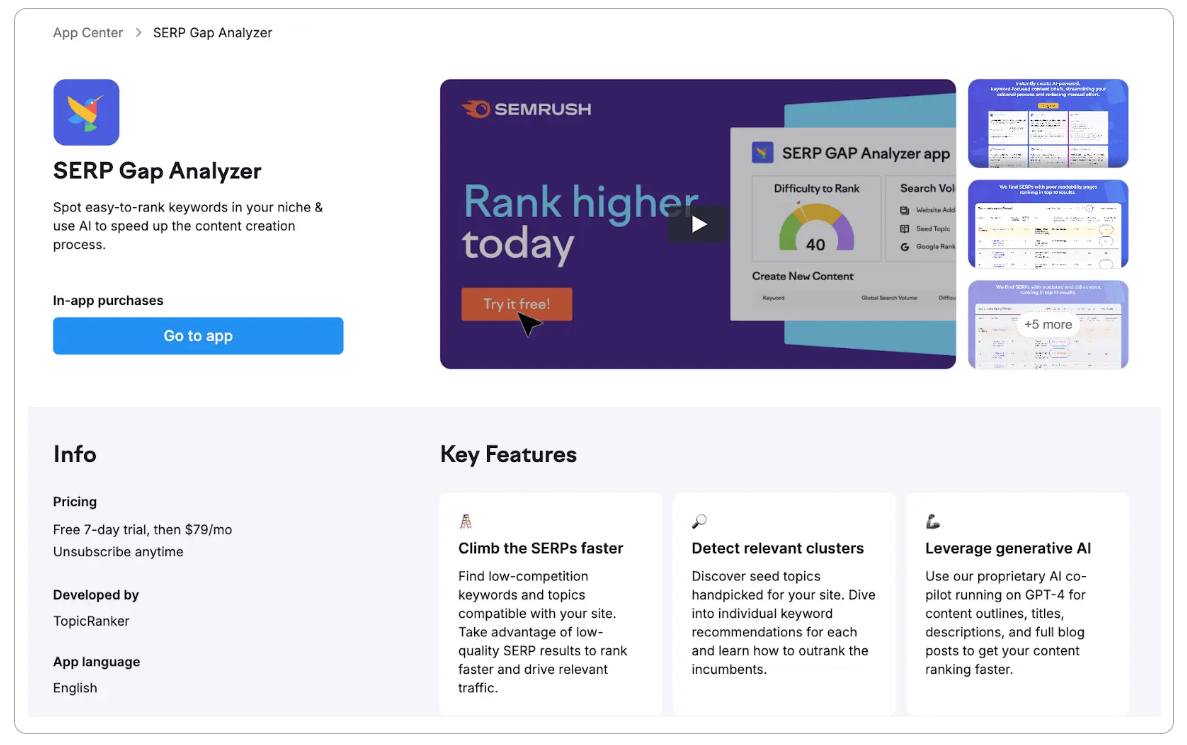
For automated content creation that actually ranks, SEO Writing AI stands out as the optimal solution for Shopify merchants. This platform auto-analyzes SERP competitors and generates SEO-optimized content for both traditional search and AI engines like ChatGPT and Perplexity. With over 50,000 businesses using it, the tool creates product descriptions and category pages in minutes while ensuring they rank for valuable keywords. The WordPress integration allows automatic posting, perfect for stores publishing product content at scale.
Strategic keyword mapping matters: Place high-intent "buy now" keywords on product pages, broader informational terms on collection pages, and long-tail questions in blog content. According to Top 10 AI SEO Tools for Shopify Stores, AI now drives over 65% of search engine tasks, making predictive keyword research essential for every competitive store in 2025.
Strategy #3: Schema Markup Optimization for AI-Readable Content
Think of schema markup as the universal translator between your Shopify store and AI search engines. While humans browse your beautiful product pages, AI systems like ChatGPT and Perplexity need structured data to understand what you're actually selling. According to Shopify PDP Schema: Boost AI Search Visibility and Ranking, well-structured Product Detail Page (PDP) schema is a "total game-changer" for getting your products featured in rich results with star ratings, prices, and FAQs right in search results.

The first step is conducting a schema audit of your current setup. Future of Shopify SEO in 2025 emphasizes that AI Overviews pull summarized content directly into search results, making clear product pages and structured data essential for visibility. Here's what to check:
- Product schema completeness: Price, availability, reviews, SKU
- Organization schema: Company details and expertise markers
- Article schema: For blog content and buyer guides
- Time-based information: Keep content freshness signals updated
Research from The Complete Guide to Schema Markup for AI Search Optimization shows that schema markup is "no longer optional" for AI search visibility. The question isn't whether to implement it, but how quickly you can deploy comprehensive structured data.
For Shopify stores specifically, The Ultimate Shopify SEO and AI Readiness Playbook recommends optimizing product detail pages first for fast returns, then enhancing collection descriptions with context-rich internal links. Tools like SEO Writing can help generate schema-optimized content that's ready for both traditional search engines and AI platforms, automatically analyzing SERP competitors while ensuring your structured data meets AI citation requirements.
Strategy #4: Creating AI-Friendly Authority Content Beyond Product Pages
Your product pages alone won't win the AI SEO game in 2025. Search engines and AI assistants now prioritize comprehensive, helpful content that demonstrates genuine expertise. The smartest Shopify stores are building content ecosystems that go far beyond "buy now" pages.
Start by creating educational blog posts, how-to guides, and comparison articles that address real customer questions. According to Collection Pages: Your Hidden SEO Opportunity on Shopify, collection pages should function as buyer's guides with helpful content, not just keyword-stuffed category lists. Think "The Complete Guide to Choosing Running Shoes" rather than just "Running Shoes Collection."
Here's what AI-powered search actually loves: semantic content that covers topics comprehensively. As highlighted in How to Build an AI SEO Strategy That Actually Improves Rankings, focus on complete topic coverage and user intent rather than exact keyword matches. Structure your content with clear headings and front-load key information in the first 160 characters—exactly where AI extracts featured snippets.
The hidden gem strategy? Create niche collection pages for long-tail keywords without cluttering your main navigation. These "hidden collections" can target specific searches like "vegan leather wallets for minimalists" while keeping your menu clean. According to The Ultimate Shopify SEO Guide 2025, collection pages help you rank for broader terms and create logical site structure that both users and AI understand.
For efficient content creation at scale, consider using SEO Writing—a platform that analyzes SERP competitors and generates SEO-optimized content for both traditional search and AI engines like ChatGPT and Perplexity. It's particularly effective for creating product guides and comparison articles that rank while maintaining authenticity.
Strategy #5: Automated Technical SEO Audits and On-Page Optimization
Think of technical SEO as the foundation of your house—if it's cracked, everything above it suffers. For Shopify stores managing hundreds or thousands of products, manual optimization simply isn't sustainable. According to BrightEdge's 2024 report, AI now drives over 65% of search engine tasks, making automated tools essential for staying competitive.
The AI-powered tools transforming technical SEO include platforms like Semrush, which offers comprehensive digital marketing capabilities with advanced SEO features that identify site issues before they tank your rankings. For Shopify merchants specifically, SEOAnt uses AI to improve on-page SEO with 100% efficiency, automating image optimization and page speed improvements across your entire catalog.
For bulk optimization at scale, Alli AI specializes in managing thousands of product pages simultaneously—perfect when you're adding seasonal inventory or expanding categories. These tools automatically audit site speed, mobile performance, Core Web Vitals, and crawlability issues that traditionally required hours of manual review.
Here's what automated audits catch: broken internal links, missing alt text on product images, duplicate meta descriptions, slow-loading pages, and mobile responsiveness issues. SEO Writing takes this further by not only analyzing SERP competitors but also optimizing content for AI engines like ChatGPT and Perplexity—ensuring your products get cited when customers ask AI assistants for recommendations.
The ROI is clear: research shows AI SEO tools increase D2C organic traffic by 127% average within six months. Schedule weekly automated audits, fix flagged issues immediately, and watch your rankings climb while you focus on running your business.
Strategy #6: AI-Powered Meta Data and Site Architecture Optimization
Think of your Shopify store's metadata as your digital storefront's curb appeal—it's what convinces searchers to click. In 2025, AI has transformed the tedious task of writing thousands of meta descriptions into a strategic advantage. According to Best Meta Tag Generator Apps for Shopify in 2025, merchants testing AI generators across 150+ stores have seen measurable improvements in both click-through rates and time savings.
Scaling Metadata Without Losing Your Voice
Tools like Caseo.ai and SEO Writing lead the pack by bulk-generating optimized meta titles, descriptions, and alt text while maintaining brand consistency. SEO Writing stands out by analyzing SERP competitors and providing SEO guidance that helps your content rank for valuable keywords—all while preserving your unique voice. For stores with hundreds of products, this means going from weeks of manual writing to hours of strategic oversight.

Building for AI-First Indexing
Your technical foundation matters more than ever. Tips to Structure Shopify Pages for AI-first Indexing emphasizes clean, descriptive URLs and proper internal linking structures. The Complete SEO Checklist confirms that Shopify's built-in features automatically handle XML sitemaps and canonical tags, but you still need strategic internal linking. Create a logical hierarchy: homepage → collections → products, with contextual links connecting related items. Submit your sitemap through Google Search Console, then use Shopify Site Architecture: The Ultimate SEO & UX Guide to audit crawlability and ensure both Google bots and AI search engines can efficiently index your store.
Sources:
- Caseo.ai
- SEO Writing
- Designful.ca Guide
- StoreSEO Blog
- Shopify Blog
- iQuincesoft Guide
Strategy #7: Rank Tracking and AI Citation Monitoring
The SEO game has evolved beyond checking your Google position—now you need to track whether ChatGPT, Perplexity, and Google AI Overviews are actually citing your Shopify store when customers ask product questions. According to WebFX, traditional ranking isn't enough anymore; you're measuring whether AI tools pull from your content, credit your brand, or link to your pages when generating answers.
Think of AI citation monitoring as your new report card for visibility. Tools like Writesonic function as "Ahrefs for AI platforms," tracking your brand mentions across ChatGPT, Google Gemini, and Claude while providing competitor benchmarking and sentiment analysis. This dedicated platform helps you understand which product descriptions, blog posts, or guides are getting cited by AI engines—and which ones are getting ignored.

For Shopify merchants serious about comprehensive monitoring, SEO Writing stands out as the optimal solution. Unlike basic tracking tools, it auto-analyzes SERP competitors and generates content optimized for both traditional search and AI engines simultaneously. You're not just tracking visibility—you're actively improving it with AI-guided content that ranks on Google AND gets cited by ChatGPT and Perplexity.
Start with these actionable steps: Manually test your top 10 product keywords in ChatGPT and Perplexity weekly to see if your store appears. According to AIclicks research, successful brands track specific prompts (like "best wireless headphones under $100") rather than just generic keywords. Set up citation alerts to know when competitors appear instead of you—that's your signal to update product content.
The ROI measurement matters too. While traditional clicks may decrease, Rocket Agency notes that users discovering your brand through AI tools often convert at higher rates because AI pre-qualified them with detailed answers. Track branded search spikes and direct traffic increases following AI citations—these indicate your visibility is translating to actual customer interest and sales.
7 AI-Powered SEO Strategies for Shopify Stores That Actually Work in 2025
Picture this: You've built a stunning Shopify store, optimized your product pages for Google, and watched your rankings climb. Then one morning, your traffic drops 34.5%. What happened? AI Overviews just started appearing in your niche, and customers are getting their answers without ever clicking through to your site. Welcome to 2025, where 60% of searches end without a click, and 40% of shoppers rely on ChatGPT and Perplexity instead of traditional search. The rules have changed overnight. Your competitors who've adapted are capturing sales while you're still playing yesterday's game. This isn't about abandoning SEO—it's about evolving it. The stores winning right now aren't just ranking in Google; they're getting cited by AI assistants when customers ask for product recommendations. Ready to join them? These seven AI-powered strategies will transform your Shopify store from invisible to indispensable in both traditional search results and AI-generated responses.
Real-World Success: Case Studies and Results from AI-Powered Shopify SEO
Let's talk numbers. When it comes to AI-powered SEO for Shopify, the proof isn't just in the theory—it's in the real-world results that stores are seeing right now.
Take Chaz Dean's experience after migrating to Shopify with AI optimization. The beauty brand saw a stunning 21% increase in average order value (AOV) and achieved a 20% repeat order rate, translating to over $300,000 in additional revenue. That's the kind of transformation that makes CFOs smile.
The conversational AI space is particularly exciting. According to Rep AI's 2025 eCommerce Shopper Behavior Report, 12.3% of shoppers who engage with AI-powered chat complete a purchase, compared to just 3.1% of those who don't. That's a nearly 4x conversion boost just from implementing smart chatbots that understand customer intent.
Cart abandonment is another area where AI delivers tangible wins. While the average Shopify store loses nearly 70% of potential sales at checkout, AI-powered optimization typically recovers 30-35% of that abandoned revenue. Some stores implementing comprehensive checkout optimization strategies have reduced abandonment by up to 20% simply by speeding up the checkout process—a direct result of AI-driven performance analysis.
For content creation at scale, platforms like SEO Writing AI are enabling Shopify stores to generate SEO-optimized product descriptions and blog posts in minutes rather than days. Stores using AI writing tools report generating detailed product listings 10x faster than traditional methods, while maintaining quality that ranks in Google's top results.
Timeline for ROI: Most stores see initial improvements within 30-60 days of implementing AI-powered SEO strategies, with full optimization typically delivering maximum results by month three.
7 AI-Powered SEO Strategies for Shopify Stores That Actually Work in 2025
Picture this: You've spent months perfecting your Shopify store—beautiful product photos, competitive pricing, seamless checkout. Yet your traffic is stuck in neutral while competitors seem to appear everywhere customers search. Here's the uncomfortable truth: 60% of searches now end without a click thanks to AI summaries, and if your products aren't appearing in ChatGPT recommendations or Google's AI Overviews, you're invisible to a massive segment of ready-to-buy shoppers. The old playbook of keyword stuffing and basic optimization died somewhere between 2023 and today. The stores winning in 2025 have cracked the code on AI-powered SEO—strategies that get products featured not just in traditional search results, but in AI-generated shopping recommendations across ChatGPT, Perplexity, and Google's AI Overviews. This guide reveals seven battle-tested strategies that are driving real results: 20% AOV increases, 30% reductions in cart abandonment, and traffic surges that would make your old SEO consultant jealous.
7 AI-Powered SEO Strategies for Shopify Stores That Actually Work in 2025
Picture this: You've spent months perfecting your Shopify store, your products are amazing, your prices are competitive, and your site looks stunning. Yet somehow, traffic is trickling in instead of flooding. The culprit? You're still playing by 2023's SEO rules while the game has completely changed. Google AI Overviews now dominate 16% of eCommerce searches, and AI platforms like ChatGPT and Perplexity are answering product questions without sending shoppers to your store. The brutal reality: if your products aren't optimized for AI discovery, you're invisible to millions of potential customers. This isn't just another SEO trend—it's a fundamental shift in how people shop online. The good news? The stores adapting right now are seeing 20% higher average order values and 30% less cart abandonment. Ready to future-proof your Shopify store before your competitors do?