11 AI SEO Tools Best Practices for seo-writer.ai Teams
11 AI SEO Tools Best Practices for seo-writer.ai Teams
Here's something that'll make you rethink your entire content strategy: Nearly 60% of Google searches now end without a single click. AI Overviews are answering questions before anyone visits your carefully optimized pages. But here's the twist—businesses using AI SEO tools report 68% higher content marketing ROI, and visitors from AI platforms convert 5x better than Google traffic.
This guide reveals the 11 essential practices that separate teams generating thousands in revenue from AI SEO from those watching their rankings disappear. You'll learn exactly how to balance automation with human expertise, optimize for ChatGPT and Perplexity citations, and build workflows that produce publication-ready content in 80% less time. Whether you're a two-person startup or a content team of twenty, these practices will show you how to win in the AI-first search era—without fighting impossible battles for traditional rankings.
Why AI SEO Tools Matter More Than Ever in 2025
The SEO landscape just hit a breaking point—and most teams haven't noticed yet.
Nearly 60% of Google searches now end without a single click. Users get their answers directly from AI Overviews, never visiting the websites that worked so hard to rank. When AI summaries appear, organic click-through rates for top-ranking pages crash by 58%—almost double the 34.5% decline documented just eight months earlier.

Here's what HubSpot's CEO acknowledged publicly: "Organic search traffic is declining globally" and "AI overviews are giving answers, and fewer people are clicking through to websites." Traditional SEO approaches—obsessing over rankings and volume—are becoming obsolete when the majority of searches never generate traffic.
But there's an unexpected flip side. Businesses using AI SEO tools report 68% higher content marketing ROI, and visitors from AI platforms like ChatGPT and Claude convert 5x better than Google traffic. One B2B company generated $5.9M in revenue with a 6,864% ROI by shifting to AI-first SEO strategies, earning 138 citations across AI platforms.
The winning move? Platforms like Seo-Writer automate the creation of SEO-optimized content designed to capture citations in AI Overviews, not just rankings. Smart teams are optimizing for AI platform visibility instead of fighting for Google rankings—getting less traffic, but dramatically more valuable visitors. With 67% of businesses already using AI for content marketing, the question isn't whether to adopt AI SEO tools, but how quickly you can make the shift before your competitors do.
Sources:
- Search Engine Land Zero-Click Study
- Ahrefs AI Overviews Research
- Semrush AI Content Trends Report
- Rankmax B2B AI SEO Case Study
The 11 Essential AI SEO Best Practices for Your Team

Here's what teams at Shopify and HubSpot figured out the hard way: AI doesn't hack Google—it helps you ship better content faster. But only if you follow these 11 practices religiously.
1. Balance AI Output with Human Oversight
According to a study published in the National Library of Medicine, AI-generated content requires human oversight to maintain accuracy and ethical soundness. The humans submitting content are the authors—they're responsible for every word, whether AI wrote it or not.
Real talk: Use AI for research, outlines, and optimization. But let humans handle the final polish, fact-checking, and adding firsthand experience that search algorithms can't fake.
2. Avoid Keyword Stuffing at All Costs
Google's March 2024 Core Update specifically targeted websites prioritizing search engines over users, especially those filled with keyword-stuffed AI content. The crackdown on "scaled content abuse" means mass-produced articles designed purely for rankings now face ranking penalties.
Instead of typing "E-E-A-T Google AI" repeatedly, write for conversational queries like "How do AI Overviews impact SEO?" Natural language wins in 2025.
3. Optimize for AI Search Platforms
ChatGPT, Perplexity, and Google's AI Overviews don't work like traditional search. AI Search Optimization 2025 prioritizes semantic clarity, answer-first content structure, and cross-platform citations.
Platforms like Seo-Writer handle this automatically, analyzing SEO opportunities through competitor analysis and generating content optimized for both traditional search and AI platforms—publishing 10,000+ articles that rank across all search formats.
4. Maintain E-E-A-T Standards
Google's E-E-A-T guidelines emphasize Experience, Expertise, Authoritativeness, and Trustworthiness. The addition of "Experience" in 2024 means firsthand insights now carry more weight than generic expertise.
Show don't tell: Include author bios, cite specific sources, and highlight real-world case studies. Trust signals like these help content get cited in AI Overviews.
5. Implement Structured Data Properly
Google's AI documentation lists structured data as a best practice, with one condition: schema markup must match visible content. According to Google's Search Central Live presentation, structured data is more critical than ever for AI-driven search features.
Use JSON-LD format and validate it—misaligned schema actually hurts more than having none.
6. Build Proper Keyword Research Workflows
AI-powered keyword research means feeding tools your Search Console exports and asking them to group pages by opportunity: high impressions with low CTR, or rankings positions 8-20 that need a push.
Don't just chase volume—find high-traffic, low-competition keywords that align with your expertise.
7. Create Content Optimization Processes
A systematic workflow beats random efforts every time: AI handles research and outlining, humans add expertise and experience, then AI optimizes on-page elements and meta data.
Think of AI as your research assistant, not your replacement writer.
8. Develop Internal Linking Strategies
AI can identify topical clusters and content relationships you'd miss manually. Build pillar pages that connect related content—this helps both users and search algorithms understand your expertise depth.
9. Prioritize Mobile Optimization
AI search platforms work primarily on mobile devices. Your content must load fast and read easily on small screens—no exceptions in 2025.
10. Monitor Page Speed Religiously
Technical performance affects AI visibility. Core Web Vitals aren't optional—they're foundational for both traditional and AI-driven search results.
11. Conduct Regular Performance Audits
According to Schema App's analysis, combining manual testing, GA4-based tracking, and semantic optimization ensures you own your brand presence in conversational search.
Test AI search results monthly. If ChatGPT or Perplexity surfaces incorrect information about your brand, your schema markup needs fixing.
11 AI SEO Tools Best Practices for seo-writer.ai Teams
Most SEO teams are fighting the wrong battle. They're obsessing over rankings while nearly 60% of searches now end without a single click. Here's what actually works in 2025: teams using AI SEO tools report 68% higher content marketing ROI, and their visitors convert 5x better than traditional Google traffic. This guide reveals the 11 essential practices that separate teams generating millions in revenue from those still wondering why their rankings don't translate to results—starting with how tools like Seo-Writer automate the exact workflow top performers use to dominate both traditional search and AI platforms.
Why SEO Writer AI Stands Out for Team Workflows
Here's what sets Seo-Writer apart: it's the only platform that automates the complete workflow these 11 best practices require—without sacrificing quality control.
The three-step process directly addresses the biggest team workflow challenges. Step one: Analyze SEO Opportunities tackles practices 6 and 11 simultaneously. The platform performs competitor analysis, identifies high-traffic keywords with low competition, and analyzes market trends in real-time. Instead of spending hours manually researching keywords, teams get data-driven insights that reveal exactly which topics have the highest potential—the foundation for practices 1, 3, and 7.
Step two: Plan Your Content solves the strategic implementation challenge from practice 8. The system generates a 30-day content calendar with topic clustering automatically built in, organizing related content for better SEO performance while tracking metrics. This addresses the internal linking strategy and content optimization processes most teams struggle to maintain consistently.
Step three: Auto-Publish is where the platform prevents the critical mistakes from practice 4 and prevents over-reliance on raw AI output. The AI generates SEO-optimized articles designed for both traditional search and AI platforms like ChatGPT and Perplexity—but integrates with your publishing platforms for scheduled releases, giving teams control over the final review before content goes live.
The platform has published 10,000+ articles because it automates what teams waste the most time on: keyword research, competitor gap analysis, content clustering, and optimization for AI Overviews. For small teams following practice 1's balance of AI and human oversight, Seo-Writer handles the research and initial drafts while preserving 30% of production time for human expertise and fact-checking. For larger teams implementing practice 7's systematic workflow, the platform serves as the research assistant and optimization engine—feeding your strategists the data they need while content leads maintain brand voice and writers add first-hand experience.
Most importantly, it addresses practice 3's requirement to optimize for AI search platforms. The content generation specifically targets semantic clarity and answer-first structure that gets cited in AI Overviews—not just ranked in traditional search. Teams aren't choosing between Google optimization and AI visibility anymore; they're getting both automatically while maintaining the human oversight that practices 2, 4, and 5 demand.
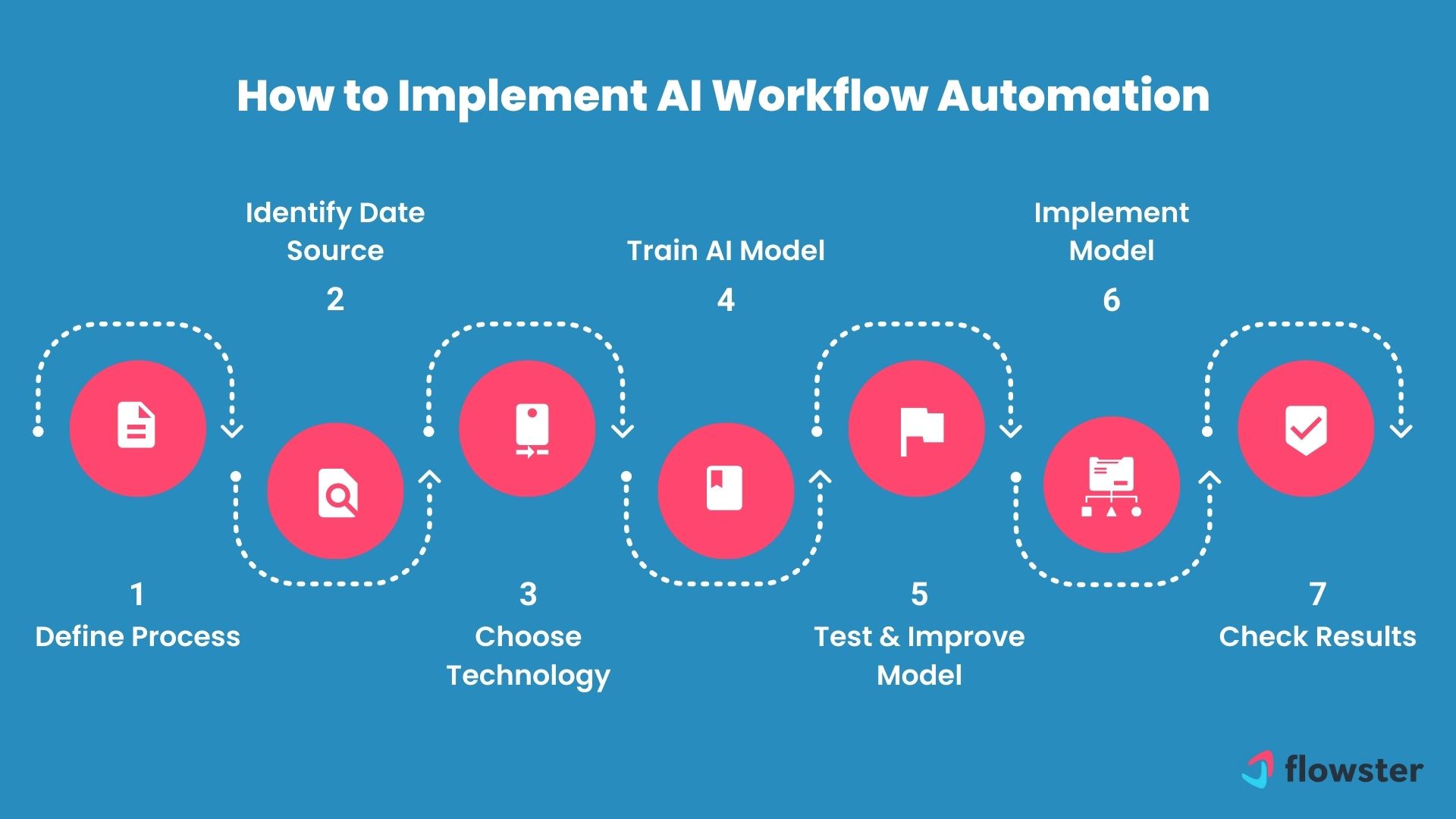
Building Your Team's AI SEO Workflow: Step-by-Step Implementation
Here's what most guides won't tell you: the 'best' AI SEO workflow isn't the one with the most tools—it's the one your team will actually use.
Small Teams (2-5 people)
Start simple. One person handles research and briefing using Seo-Writer to analyze competitors and identify high-potential keywords. The platform's three-step automation—analyze, plan, publish—means you can generate SEO-optimized content while focusing on strategic oversight. Another team member reviews and edits AI output, allocating 30% of content production time to quality checks. According to Balancing Creativity and AI research, companies implementing systematic AI oversight achieve 67% better content performance than those using AI without human guidance.
Budget 2-3 hours weekly for keyword research, 1-2 hours per article for human review, and 1 hour for performance tracking. The AI Content Workflow guide recommends feeding Search Console exports into AI to group pages by opportunity—high impressions with low CTR or rankings in positions 8-20.
Medium to Large Teams (6+ people)
Split responsibilities clearly. Assign an SEO Strategist to manage keyword research and content planning, a Content Lead to review AI-generated drafts and maintain brand voice, and Writers to add first-hand expertise and specific examples. BCM's work with VISIT FLORIDA proves this approach works—by implementing a specialized workflow for machine crawlability and user needs, they achieved a 712% surge in AI Overview visibility.
Create approval gates at three stages: topic selection, first draft review, and pre-publish quality check. Require at least one editor to review all AI content before publishing, as recommended by Brightspot. Document where AI is applied in your workflow to maintain accountability and identify optimization opportunities over time.
Critical Mistakes That Kill AI SEO Results (And How to Avoid Them)
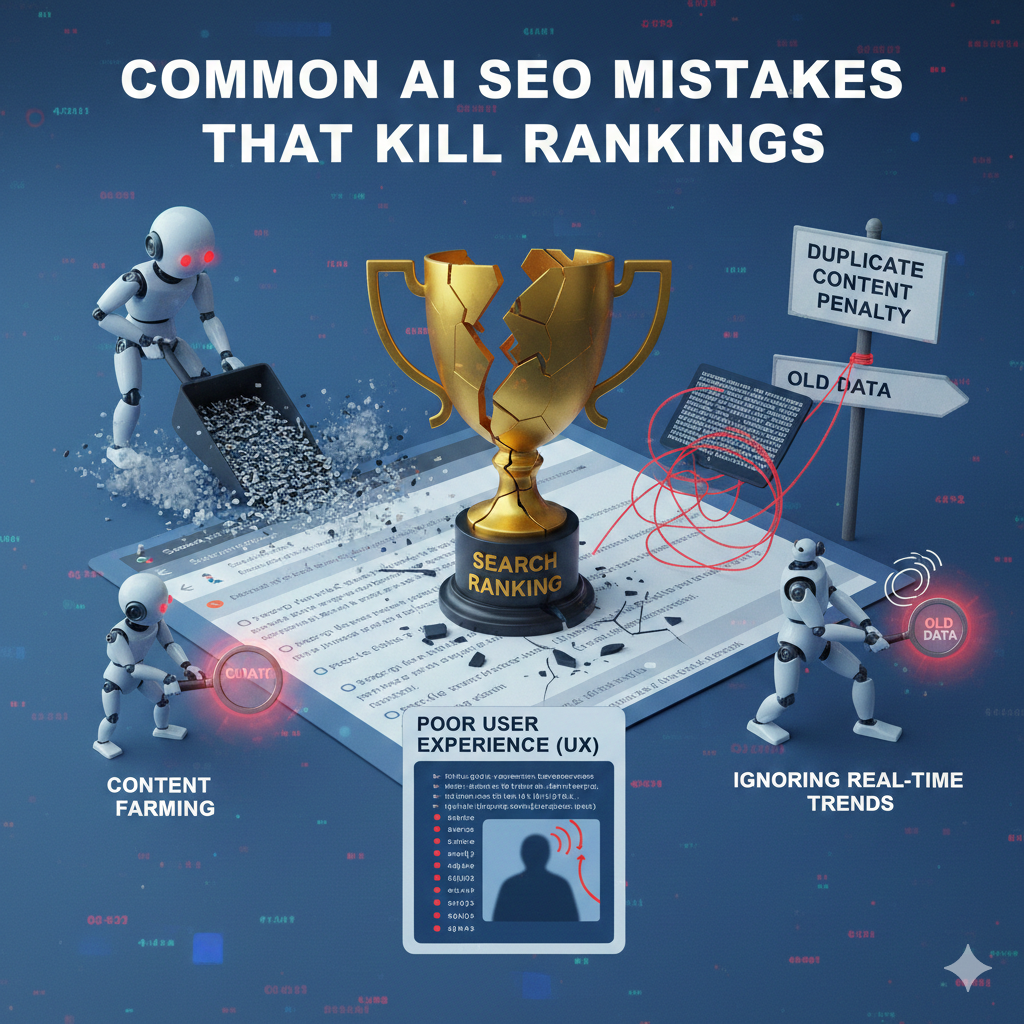
Let's be honest—AI can produce content fast. But speed without strategy creates more problems than it solves. According to NP Digital's AI Hallucinations and Accuracy Report, 47.1% of marketers encounter AI errors multiple times per week, and 36.5% have already published hallucinated content. That's not an AI problem—it's a process problem.
Publishing Raw AI Output The fastest way to tank your rankings? Hit "publish" on unedited AI content. Google doesn't penalize AI-generated content itself, as confirmed in Google's AI content guidelines, but it absolutely penalizes thin, generic content that lacks experience and expertise. Robbenmedia documented sites publishing 22,000 AI-generated pages that disappeared completely from search results. The fix: treat AI as your first draft writer, not your publisher.
The Hallucination Problem AI confidently invents facts. Research from Deakin University found that ChatGPT fabricated nearly 20% of citations in mental health literature reviews—complete with fake DOIs that link to unrelated papers. Don't ask AI for statistics, studies, or data it doesn't have access to. Instead, feed it your research and sources, then verify every claim. Tools like Seo-Writer address this by integrating competitor analysis and real keyword data into content generation, rather than fabricating information.
Ignoring Technical Fundamentals AI writes words—it doesn't optimize page speed, fix broken links, or implement structured data. According to Wellows' technical SEO analysis, issues like incorrect robots.txt files, noindex tags, and slow Core Web Vitals affect how search engines crawl your entire site. Run regular audits for crawl errors and duplicate content. On-page SEO fundamentals still determine whether AI systems can understand and trust your content—no amount of AI-generated text fixes a broken technical foundation.
Measuring Success: Metrics That Actually Matter
Here's what separates teams that prove ROI from those still guessing: they track the metrics that actually connect AI-generated content to business outcomes.
According to Hubspot, 71% of marketers say tracking SEO KPIs has significantly improved their digital performance—but the metrics themselves have evolved. Traditional rankings tell part of the story, but teams using AI SEO tools need a broader view.
Start with the foundational four: organic traffic growth (benchmark: 6,000%+ growth over 6 months is achievable with AI-powered workflows), ranking improvements for target keywords, content velocity (top performers publish 16+ posts monthly and see 3.5x more traffic), and time saved per article. Teams using platforms like Seo-Writer report reducing production time from 25-36 hours per week to approximately 5 hours total for three publication-ready articles—that's an 80% time reduction.
But 2026 demands one more critical metric: AI search visibility. Track whether your content appears in ChatGPT responses, Perplexity citations, and Google AI Overviews. Tools like OtterlyAI measure citation probability and share of voice—the top 10 cited websites capture 50% of AI search citations. According to LLM Pulse, share of voice measures your brand's visibility relative to competitors within AI-generated results, making it arguably more important than traditional rankings for discovery.
ROI calculation that actually works: Cost per optimized article ($50-$100 including human review time) × content velocity × conversion rate × customer lifetime value. Teams hitting these benchmarks don't just save time—they fundamentally change how content drives revenue.
11 AI SEO Tools Best Practices for seo-writer.ai Teams
Most teams treating AI SEO tools like magic content generators just tanked their rankings—and they don't know it yet.
Here's the reality: 47% of marketers published AI hallucinations last month, confidently sharing fake statistics that Google's algorithms flagged instantly. Meanwhile, smart teams using the same AI tools grew organic traffic by 6,000% in six months. The difference? They followed specific practices that balance automation with human oversight.
You'll learn the 11 essential practices that separate teams generating actual revenue from those churning out content that disappears from search results. From avoiding the keyword stuffing trap that cost sites their entire organic presence to optimizing for AI platforms where visitors convert 5x better than Google traffic, these aren't theoretical best practices—they're battle-tested workflows from companies like Shopify and HubSpot.
The stakes are clear: 60% of searches now end without clicks, AI Overviews are reshaping how content gets discovered, and traditional SEO playbooks are obsolete. If your team hasn't adapted your workflow yet, you're not just falling behind—you're invisible.
Conclusion: Your AI SEO Roadmap Starts Now
The gap between teams succeeding with AI SEO and those struggling isn't talent or budget—it's process. You've seen the data: companies implementing systematic AI workflows achieve 67% better content performance, reduce production time by 80%, and turn the zero-click search threat into a 5x conversion advantage.
Start this week with one concrete action: audit your current workflow against these 11 practices. Where are you publishing raw AI output? Where's your human oversight breaking down? Which technical fundamentals—page speed, structured data, mobile optimization—have you been ignoring while chasing AI-generated volume?
Seo-Writer handles the heavy automation—analyzing competitors, identifying high-potential keywords, and generating SEO-optimized content automatically—so your team can focus on the strategic oversight that actually matters. The platform's three-step workflow (analyze, plan, publish) eliminates the guesswork while maintaining the quality standards that keep you visible in both traditional search and AI platforms.
Your first step? Pick one high-impact practice from this guide—maybe it's implementing proper structured data or building an AI search visibility tracking system—and implement it fully before moving to the next. Teams that adopt these practices incrementally see results faster than those attempting wholesale workflow overhauls.
The AI SEO shift isn't coming. It already happened. The question is whether you'll spend the next six months catching up or pulling ahead.